Case studies

From practice: starting point, approach, result.

Three projects from calender and film production, anonymized. We are happy to share customer names, line designations and detailed figures in a personal conversation.

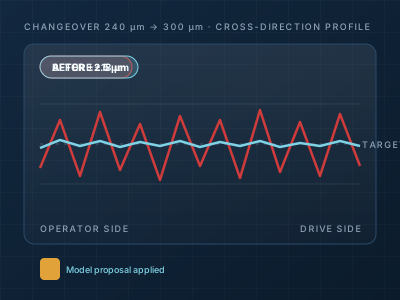
Animated illustration: thickness profile before and after the changeover
Process technology · Calendering

Changeover without start-up scrap: VR calender model at a PVC film manufacturer

Industry
Rigid PVC film for packaging
Line
4-roll L-calender, Eastern Europe
Partner
Technical University of St. Petersburg

Starting point

Thickness changeovers (e.g. from 240 µm to 300 µm) were “dialed in” on the running calender: several iterations of roll gap, roll bending and roll crossing, each time with start-up scrap and downtime. New calender operators could only learn on the producing line.

Approach

The model of the flow and heat processes in the roll nip, developed together with the Technical University of St. Petersburg, was parameterized with the data of the line: roll geometry and slip properties, rheological equation of state of the recipe, heat transfer. The changeover was calculated in advance on the model; input was made directly in the VR headset with images of the customer's own line.

Result

  • Mean film thickness, calendered width per roll and throughput for 300 µm determined in advance
  • Roll bending and roll crossing optimized for minimum thickness tolerance before the line was changed over
  • Changeover in a single pass instead of several iterations – less scrap, shorter changeover time
  • New calender operators train changeovers on the model without occupying production

Project description with images of the application: PDF (DE) · PDF (EN)

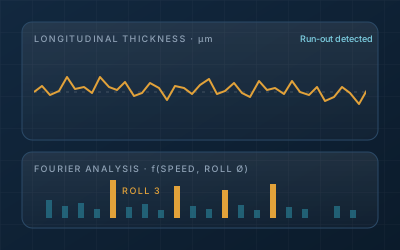
Animated illustration: longitudinal thickness profile with Fourier analysis
Offline measurement technology · Maintenance

Bearing damage detected before the roll failed: longitudinal thickness profile with Fourier analysis

Industry
Calendered film
Task
Periodic thickness variations in the machine direction
Partner
MFS

Starting point

The film showed thickness variations in the machine direction that could not be captured with the cross profile measurement. Complaints were piling up, and the cause was unclear: recipe, drives or rolls?

Approach

Thickness measurement over the film length, taking into account the individual roll diameters and speeds. Fourier analysis was used to determine the frequencies of the variation and to assign them to the individual rolls via rotational speed and diameter.

Result

  • One dominant frequency corresponded exactly to the rotation of one roll: run-out error caused by incipient bearing damage
  • Bearing replacement scheduled for the next maintenance window instead of an unplanned stop
  • Measurement method established as a recurring inspection – preventive maintenance based on the film itself

Further reading: Expert article on longitudinal thickness variations

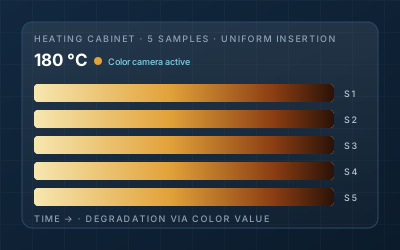
Animated illustration: residual thermal stability of five samples in the heating cabinet
Offline measurement technology · Raw material

Stabilizer content optimized for thermoforming: residual thermal stability in the heating cabinet

Industry
PVC film for thermoforming
Task
Thermal degradation at the converter
Partner
MFS · Technical University of St. Petersburg

Starting point

Films that left production in perfect condition discolored during thermoforming. The converter filed complaints, and the manufacturer had no test value describing the remaining thermal load capacity.

Approach

Residual thermal stability measurement: up to five samples simultaneously with uniform insertion into a heating cabinet, evaluation of thermal degradation via color camera analysis along the sample. Comparison of several stabilizers and dosages under identical conditions.

Result

  • Objective characteristic value for the residual thermal stability of each batch – as a release criterion before shipment
  • Stabilizer content matched to the actual thermal load during thermoforming
  • Comparison of stabilizers revealed savings potential at the same level of safety

A similar task on your line?

In a 30-minute initial consultation we clarify whether and how we can help – without obligation.

Request initial consultation